
Lookah Python Review: The Best Mid-Range Dab Pen?

The Lookah Python Is What a $50 Dab Pen Should Feel Like
Most dab pens at $49.99 feel like budget devices trying to look mid-range. The Lookah Python feels like a mid-range device that happens to be priced accessibly. The difference is in the materials, the engineering decisions, and the details that only show up after you’ve handled the device for a few sessions.
We’ve run the Python through its paces — multiple concentrate types, all three voltage settings, extended sessions testing the battery and the coil over time. This review covers what it actually does, where it stands in the market, and who it’s the right buy for.
🛒 QUICK VERDICT:
→ Price: $49.99
→ Best for: Regular concentrate users who want a premium-feeling mid-range device with a built-in tool, digital display, and 710 quartz dish coil
→ Not for: Users who prioritize battery life over form factor, or who want temperatures below 3.4V for live rosin
→ Verdict: Buy it — the build quality, feature set, and 710 quartz dish coil are hard to match at this price
First Impressions: This Device Has Presence

The Python arrives in proper packaging and the device itself commands attention. The zinc-alloy body with its serpentine texture pattern — inspired by the snake it’s named for — is unlike anything else in the $40–60 dab pen market. Most devices in this range are cylindrical bars or rectangular slabs. The Python has a shape and a design language that feels intentional.
It’s heavier than expected for its size — the zinc-alloy construction adds real weight compared to plastic or thin aluminum competitors. In the hand it feels like something worth $50. That sounds like a low bar but in the dab pen category at this price it genuinely isn’t.
The flip-top lid opens with one thumb — press the release and it snaps open cleanly. The magnetic closure snaps shut with satisfying resistance. The 360° swivel mouthpiece rotates freely and locks in any direction. These are small mechanical details that most users will use hundreds of times and that either work well consistently or become sources of friction. On the Python they work well consistently.
The 710 Quartz Dish Coil
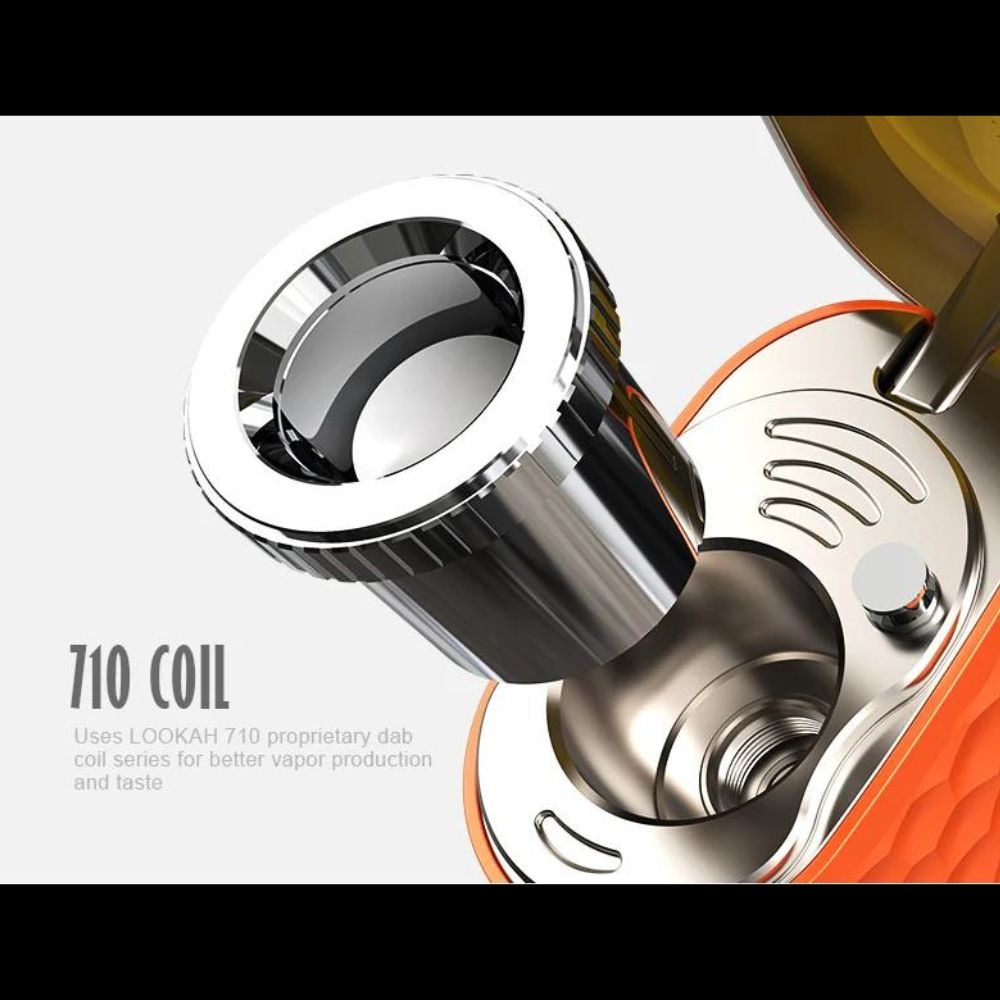
This is the Python’s most important spec and it’s worth understanding specifically what it means.
A 710 quartz dish coil uses a flat quartz plate as the heating surface — no exposed metal wire rods. Your concentrate sits on the quartz dish, the coil heats the quartz from below, and the quartz distributes that heat across the flat surface. The dish geometry means concentrate spreads across a wide, flat area rather than pooling around a central coil element. More surface contact, more even heating, more complete extraction per load.
The “no exposed metal wire rods” part matters because wire rod coils — the kind found in budget dab pens — create hot spots at the contact points. Concentrate touching the wire directly can burn or vaporize unevenly, producing harsh vapor and leaving residue that’s difficult to clean. The quartz dish eliminates those contact points. The coil heats quartz, quartz heats concentrate, and the vapor you inhale has never touched metal.
In our testing the Python’s 710 quartz dish coil produced clean, even vapor across all three voltage settings. At 3.4V with live resin the draws were flavorful and smooth. At 4.0V with shatter the vapor was dense and complete — the dish coil’s flat surface handled hard concentrates well, maintaining contact with the melting material rather than letting it flow to the edges the way a cup coil sometimes does.
The coil is also part of Lookah’s 710 ecosystem — you can swap in different 710 coil types (there are four options) if you want to experiment with a different heating geometry. This is an advantage the Python shares with the Swordfish that no competitor at this price offers.
Auto Preheat and How It Changes the Loading Experience
Power the Python on with five clicks and it runs an automatic 10-second preheat cycle before you load. The coil warms up to operating temperature before concentrate ever touches the quartz.
This matters more than it might seem for two reasons. First, loading onto a warm surface means your concentrate immediately begins to soften and adhere to the quartz rather than sitting cold on a cold surface and potentially shifting when you close the lid. Second — and more importantly for harder concentrates like shatter — a preheated quartz surface means the material starts vaporizing from the moment you close the chamber and begin your draw rather than spending the first several seconds of your draw just melting.
In practice the preheat means the Python’s first draw of any session is more productive than the first draw from a device without preheat. You’re not wasting the beginning of a session warming up the coil — it’s already warm when you load.
The Built-In Dab Tool

A metal dab tool is integrated into the flip-top lid mechanism. When the lid opens, the tool is accessible immediately — no digging through a kit, no separate container, no loose tool wandering around your setup.
After extended use this becomes one of those features that’s hard to go back from. The convenience of having your loading tool physically attached to the device sounds minor until you’ve used it every session for a week and then tried loading a different dab pen with a separate tool. The Python’s integrated design means your tool is always at the same temperature as the device, always exactly where you need it, and never misplaced.
Voltage Settings and Temperature Performance
Three voltage presets: 3.4V, 3.7V, and 4.0V. The digital LED display confirms which setting is active — no guessing from LED color.
3.4V is the starting point for most sessions. Live resin, rosin, and standard wax all perform well here. The quartz dish’s even heat distribution means 3.4V produces cleaner, more flavorful vapor than you’d get from a wire rod coil at the same voltage.
3.7V is the middle ground. More vapor density, slightly less flavor resolution. Good for standard wax, crumble, and budder. Most concentrate types have a sweet spot somewhere around here.
4.0V is where shatter, distillate, and harder concentrates belong. Maximum heat, maximum vapor production. The quartz dish coil handles high-temp sessions without the burning smell that wire rod coils produce when pushed to their upper limits.
The honest limitation: 3.4V is the floor. For users who run live rosin or fresh press at 2.5V–2.8V for maximum terpene preservation, the Python can’t get there. The Yocan Iris at $25.99 handles that range better, at a lower price, specifically because of its 2.5V floor. The Python is not the right device for ultra-low-temp live rosin sessions.
Battery Life — The Honest Assessment
650mAh is the Python’s weakest spec. For context: the Yocan Orbit at $32.99 has 1700mAh. The Lookah Swordfish at $48.99 has 950mAh. The Python’s 650mAh means daily charging for regular users — two to three sessions of normal use per charge is a reasonable expectation.
This isn’t a dealbreaker if you charge your devices at a consistent time — plug it in when you go to sleep, use it throughout the next day, repeat. But if you’re the type who charges devices infrequently and expects them to be ready on demand, the Python’s battery will frustrate you in a way the Orbit or Swordfish won’t.
USB-C charging is fast — back to full in about 90 minutes from empty.
Full Specs
- Price: $49.99
- Battery: 650mAh
- Heating: 710 quartz dish coil (Type A — no exposed wire rods)
- Coil compatibility: 4 Lookah 710 coil types
- Voltage: 3.4V / 3.7V / 4.0V (3 presets)
- Display: Digital LED
- Mouthpiece: 360° swivel, magnetic
- Lid: Magnetic flip-top with release button
- Built-in dab tool: Yes (integrated in lid)
- Auto preheat: 10 seconds on startup
- Body: Zinc-alloy with serpentine texture
- Charging: USB-C
Lookah Python vs the Competition
Python ($49.99) vs Lookah Swordfish ($48.99)

One dollar apart. Two genuinely different devices.
The Swordfish has a glass mouthpiece — borosilicate, fully inert vapor path — and a fritted quartz coil that produces arguably cleaner vapor than the Python’s dish coil. It also has 950mAh vs the Python’s 650mAh. By pure performance metrics the Swordfish edges the Python.
The Python wins on form factor and convenience. The 360° swivel mouthpiece, the flip-top with integrated dab tool, the broader 710 coil compatibility. If you load concentrates frequently and want the most convenient loading experience in the Lookah lineup, the Python is the right choice. If you prioritize vapor purity and battery life above convenience features, the Swordfish costs $1 less and delivers both.
See our full Lookah dab pens guide for the complete three-way comparison including the Ant.
Python ($49.99) vs Yocan Orbit ($32.99)
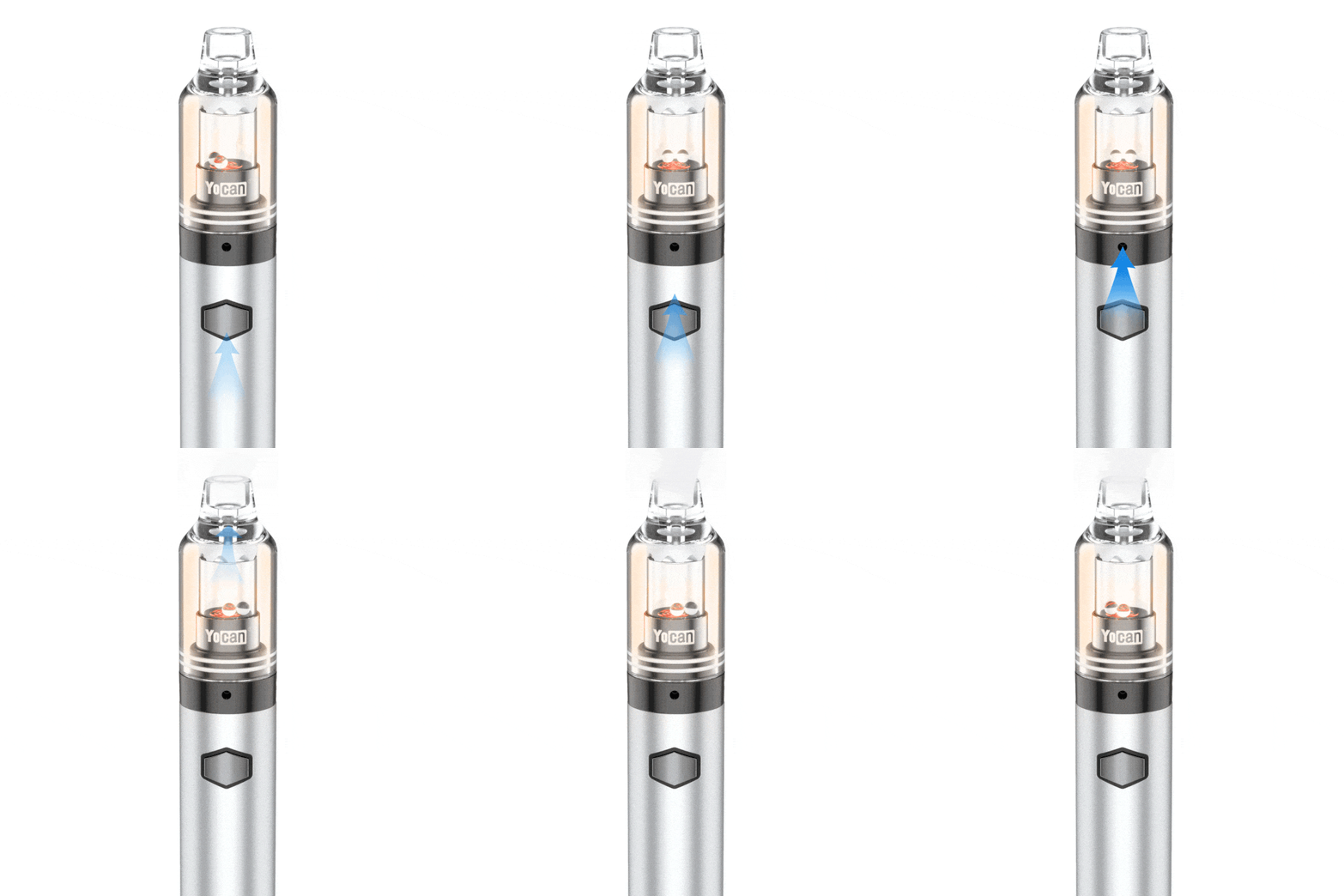
Yocan Orbit Wax Vape Pen – Spinning Terp Pearls & Coil-Less Quartz Bowl for Smooth, Flavorful Concentrate Hits
The honest comparison most buyers in this price range face.
The Orbit costs $17 less and produces better vapor. The quartz bucket design — where concentrate sits over the coil rather than on it — outperforms the Python’s dish coil on vapor quality in our testing. The Orbit’s 1700mAh battery outlasts the Python’s 650mAh significantly.
The Python wins on build quality feel, form factor, the integrated dab tool, digital display, and the Lookah design identity. If vapor quality per dollar is the primary metric, the Orbit wins. If you want a device that looks and feels more premium, has a built-in tool, and carries the Lookah aesthetic, the Python is worth the $17 premium.
Python ($49.99) vs Yocan Black Pocket ($69.99)

The Python is $20 less. The Black Pocket’s 360° all-side ceramic heating and 1°F precision are genuinely in a different performance tier. If vapor quality is the priority and budget extends to $70, the Black Pocket is the stronger buy. If the Python’s form factor, built-in tool, and Lookah design specifically appeal to you, the $20 savings is real.
Comparison Table
| Device | Price | Coil | Battery | Python Advantage |
|---|---|---|---|---|
| Lookah Python | $49.99 | 710 quartz dish | 650mAh | — |
| Lookah Swordfish | $48.99 | Fritted quartz dish | 950mAh | 360° swivel mouthpiece, built-in tool, broader coil compatibility |
| Yocan Orbit | $32.99 | Quartz bucket over coil | 1700mAh | Build quality, form factor, integrated tool, Lookah design |
| Yocan Black Pocket | $69.99 | 360° ceramic Cloud3 | 1400mAh | Lower price, built-in tool, Lookah design language |
Who Should Buy the Lookah Python
Buy it if you want the most feature-complete dab pen in the Lookah lineup. The flip-top lid, integrated dab tool, 360° swivel mouthpiece, digital display, auto preheat, and 710 quartz dish coil are a feature set that no other device at $50 matches in terms of loading convenience and build quality.
Buy it if the Lookah design language specifically appeals to you. The serpentine zinc-alloy body is genuinely distinctive. If you want a device that stands out from the sea of identical cylindrical dab pens, the Python delivers that.
Buy it if you’re a regular concentrate user who charges devices daily and won’t be caught off guard by the 650mAh battery. The Python rewards users who maintain a charging routine. It punishes users who forget.
Don’t buy it if battery life is a priority — the Swordfish at $1 less has 950mAh and the Orbit at $17 less has 1700mAh. Don’t buy it if you run live rosin at sub-3.4V — the Yocan Iris handles that at $24 less. And don’t buy it expecting vapor quality improvements over the Orbit — the Orbit’s quartz bucket produces better vapor despite costing less.
🎯 Shop the Lookah Python
Lookah Python — $49.99 — In Stock Now
Free shipping on all orders over $40. Same-day dispatch on orders before 3pm EST.
Buy the Lookah Python → $49.99
Also consider: Lookah Swordfish ($48.99) for glass vapor path and better battery — or Yocan Orbit ($32.99) for better vapor quality at a lower price.
📚 CONTINUE LEARNING:
→ Lookah Dab Pens — Python vs Swordfish vs Ant Full Comparison
→ Best Dab Pens 2026 — Full Ranked Guide
These products are for adults 21+ only. Follow all local and state laws regarding cannabis and vaping products. Use responsibly.
Last Updated: April 2026

Written by Marc Pitts
Marc is the CEO of Discount Vape Pen and has spent over 11 years in the vape industry. He began his career owning and operating brick-and-mortar vape shops, giving him hands-on experience with both products and customer needs. A Kean University graduate from Westfield, NJ, Marc combines retail expertise with a deep understanding of the evolving vaping landscape.
Outside of work, Marc loves cooking Italian food, swimming, playing tennis, and attending Broadway shows — a true theater kid at heart. Meet all our Discount Vape Pen Authors here.