Every 510 cart battery (also called a 510 thread battery) uses one of two activation methods: you either press a button to heat your cartridge, or you simply inhale and the battery fires automatically. This single difference — button-activated vs auto-draw — shapes your entire vaping experience more than almost any other feature.
But which one is actually better? That depends entirely on how you vape, where you vape, and what matters most to you. Some people swear by the control of a button. Others love the simplicity of just inhaling. And in 2026, the gap between these two styles has narrowed significantly — many modern batteries now combine both activation methods into a single device.
This guide breaks down everything you need to know about button-activated and auto-draw cart batteries so you can make the right choice for your needs. We’ll cover how each type works, the real pros and cons of both, which situations favor each style, and our top picks for both categories.
A button-activated cart battery requires you to press and hold a physical button to heat your cartridge while you inhale. No button press, no vapor. It’s completely manual — you control exactly when the heating element fires and how long it stays active.
Button batteries are the original style of 510 battery and remain the most common type on the market. They typically feature a single button on the body of the device that serves multiple functions: pressing and holding fires the battery, clicking five times quickly turns it on or off (learn more in our guide to turning on your vape battery), and clicking three times usually cycles through voltage settings.
The button gives you direct, physical control over your device. You decide when to start heating, how long to hold, and when to stop. This makes button batteries feel more intentional and precise compared to auto-draw models.
How Button Activation Works
When you press and hold the button, the battery completes an electrical circuit that sends power through the 510 threading connection and into your cartridge’s atomizer coil. The coil heats up (typically to 300–450°F depending on your voltage setting) and vaporizes the oil surrounding it. When you release the button, the circuit breaks and heating stops immediately.
Most button batteries include a safety feature that automatically cuts off power after 8–10 seconds of continuous pressing. This prevents overheating if the button gets held down accidentally.
What Is an Auto-Draw Cart Battery?
An auto-draw cart battery — also called a buttonless battery, inhale-activated battery, or draw-activated battery — fires automatically when you inhale through the mouthpiece. There’s no button to press. You just put it to your lips and breathe in. The battery detects the airflow and activates on its own.
Auto-draw batteries are designed to be as simple and intuitive as possible. If you’ve ever used a disposable vape, you’ve already experienced auto-draw activation — it works the same way. This makes the transition from disposables to a reusable 510 battery system feel natural and familiar.
Many people refer to auto-draw batteries as “buttonless,” though this term has become slightly misleading in 2026. A growing number of auto-draw batteries now include a button for secondary features like preheat or voltage adjustment, while still using inhale-activation as the primary firing method.
How Auto-Draw Activation Works
Inside every auto-draw battery is a small airflow sensor (either a pressure sensor or a microphone-style sensor) that detects when air is being pulled through the device. When you inhale, the sensor registers the change in air pressure and triggers the battery to send power to the cartridge’s coil. When you stop inhaling, the airflow stops, the sensor deactivates, and heating ceases.
The sensor sensitivity varies between devices. Some fire with a very light draw, while others require a firmer inhale. Higher-quality auto-draw batteries tend to have better-calibrated sensors that respond quickly and consistently without false activations.
How Each Activation Method Works (The Mechanics)
Understanding the mechanical difference between these two systems helps explain why each has its own strengths and weaknesses.
Button Batteries: Electrical Switch
A button battery uses a physical electrical switch. When you press the button, it mechanically closes a circuit, allowing electricity to flow from the battery cell to the 510 connector and into your cartridge. This is a simple, proven, and reliable mechanism that has been used in vaping devices since the very beginning.
Because the activation is mechanical (physical button press = power flows), button batteries offer extremely consistent performance. Every press delivers the same response. There’s no interpretation or sensor calibration involved.
Auto-Draw Batteries: Airflow Sensor
An auto-draw battery replaces the physical switch with an electronic sensor. There are two main sensor types used in 2026 devices:
Pressure-based sensors detect the slight vacuum created when you inhale through the device. These are the most common and generally the most reliable. They respond to actual airflow changes, which means they’re less likely to false-fire from ambient noise.
Microphone-style sensors detect the sound or vibration of air moving across a diaphragm. These can be more sensitive but are occasionally prone to activating from loud noises, wind, or being jostled in a pocket. Modern devices have largely solved these issues with better calibration, but budget auto-draw batteries can still suffer from this.
Side-by-Side Comparison: Button vs Auto-Draw
Feature
Button-Activated
Auto-Draw
How it fires
Press and hold button
Just inhale
Ease of use
Easy (slight learning curve)
Extremely easy
Preheat function
Yes (standard on most)
Sometimes (hybrid models only)
Variable voltage
Yes (standard on most)
Sometimes (fewer options)
Accidental firing
Unlikely (5-click lock)
Possible (pocket activation)
Best for thick oils
Yes (preheat + voltage control)
Depends on model
Feels like smoking
No (requires button coordination)
Yes (just inhale)
Discretion
Moderate
High (no visible button press)
Price range
$10–$50
$12–$45
Best for beginners
Good
Excellent
Button-Activated: Full Pros and Cons
Pros of Button Batteries
Complete control over your hit. You decide exactly when heating starts and stops. This lets you “prime” your hit by pressing the button a half-second before you inhale, ensuring the coil is already warm when you start drawing. It also lets you pulse the button for short, controlled bursts rather than continuous heating.
Preheat function is standard. Nearly every button battery includes preheat (usually activated by clicking twice). This is critical for thick oils like live resin, live rosin, and cold-weather use. Preheat gently warms the oil for 10–15 seconds at low voltage, breaking up clogs and improving flow before you take a hit. Learn more about why this matters in our cart battery features guide.
Variable voltage is standard. Button batteries almost always offer multiple voltage settings (typically 3–5 levels between 2.0V and 4.2V). This gives you meaningful control over vapor temperature, flavor intensity, and cloud size.
No accidental firing. The 5-click lock/unlock feature means your battery won’t fire in your pocket, purse, or backpack. You have to intentionally unlock it and then physically hold down the button to produce vapor. This makes button batteries safer for transport.
More feature-rich overall. Because button batteries have a physical interface (the button), manufacturers can pack in more functions: preheat, voltage cycling, session timers, puff counters, and lock modes. The button serves as the input for all of these features.
Cons of Button Batteries
Requires coordination. You need to press the button at the same time you inhale. For experienced users this is second nature, but for absolute beginners it can feel awkward at first. You might press too early (wasting oil), too late (weak first puff), or forget to press at all.
Slightly less discreet. The act of pressing a visible button while inhaling is an extra motion that makes it more obvious you’re using a vape. In situations where discretion matters, this is a minor drawback.
Button can wear out. Physical buttons are a mechanical component that can degrade over time. Cheap button batteries are especially prone to sticky, unresponsive, or wobbly buttons after several months of use.
Forgetting to lock it. While the 5-click lock prevents pocket firing, you have to remember to actually lock it. If you toss an unlocked button battery into a bag, the button could get pressed and fire continuously until the auto-shutoff kicks in (usually 8–10 seconds), potentially burning your oil.
Auto-Draw: Full Pros and Cons
Pros of Auto-Draw Batteries
Absolute simplicity. There is literally nothing to learn. Screw on your cart, put it to your lips, and inhale. The battery handles everything else. This is as close to “plug and play” as vaping gets.
Feels natural. If you’re transitioning from smoking or from disposable vapes, auto-draw feels familiar. The “just inhale” action mirrors the experience of a cigarette or disposable without any extra steps.
More discreet in use. Without needing to press a visible button, auto-draw batteries are less conspicuous during use. Paired with a concealed-style battery, an auto-draw device can be almost invisible in public.
One-handed operation. No need to coordinate a button press with your inhale. Just bring it to your mouth and draw. This is convenient while walking, cooking, or any situation where one hand is occupied.
No lock/unlock needed. Auto-draw batteries are always “ready” when you are. There’s no 5-click sequence to remember. Pick it up and use it.
Cons of Auto-Draw Batteries
Limited features on pure auto-draw models. Batteries that are exclusively auto-draw (no button at all) typically lack preheat, variable voltage, and other power features. You get what you get — usually a single fixed voltage. This has improved significantly in 2026 with hybrid models, but pure buttonless batteries are still more limited.
Possible accidental activation. Auto-draw sensors can sometimes fire when they shouldn’t — in a windy environment, from being bumped in a pocket, or even from loud ambient noise (with microphone-style sensors). Modern devices have mostly solved this, but budget models can still have this issue.
Less control over your hit. You can’t pre-fire the coil before inhaling. The heating only starts when airflow is detected, which means the first fraction of a second of your draw is unheated. For most users this is negligible, but precision-focused vapers notice the difference.
Sensor can get clogged. Oil that leaks or condensation that builds up around the airflow sensor can cause it to malfunction — either firing randomly or not firing at all. This is the most common auto-draw-specific problem. Keeping the mouthpiece area and airflow channel clean is important.
Not ideal for all oil types. Without preheat, auto-draw batteries can struggle with very thick oils (especially live resin or concentrates in cold weather). The oil may be too viscous for the coil to vaporize efficiently on the first draw, resulting in weak or burnt-tasting hits.
Hybrid Batteries: The Best of Both Worlds
One of the biggest trends in 510 batteries over the past two years is the rise of hybrid batteries that offer both button activation and auto-draw in the same device. These dual-mode batteries let you choose your activation method on the fly.
With a hybrid battery, you can inhale to fire (auto-draw mode) for quick, casual hits, and use the button when you want preheat, voltage adjustment, or more precise control. This effectively eliminates the need to choose between the two styles.
How Hybrid Batteries Typically Work
Most hybrid batteries default to auto-draw mode but include a button for additional functions. The button handles preheat (usually 2 clicks), voltage cycling (usually 3 clicks), and power on/off (5 clicks). Meanwhile, the airflow sensor handles the actual firing whenever you inhale.
Some hybrids let you toggle between modes — using button-only, auto-draw-only, or both simultaneously. This level of flexibility is now available even in mid-range price points ($25–$40).
Are Hybrid Batteries Worth It?
In most cases, yes. If you’re unsure whether you prefer button or auto-draw, a hybrid battery removes the guesswork entirely. You get to experiment with both methods on the same device and settle into whatever feels natural. The price premium over a dedicated button or auto-draw battery is usually minimal ($5–$10).
💡 Pro Tip: Many of today’s most popular conceal-style batteries (the kind that hide your cart inside the body) are hybrids. They use auto-draw as the primary activation but include a button for preheat and voltage control. Browse our concealed battery collection to see options.
Who Should Choose Which?
Choose Button-Activated If You:
Want full control over your vaping experience
Use thick oils (live resin, rosin, heavy distillate) that benefit from preheat
Want to fine-tune your voltage for different cartridge types
Carry your battery in a pocket or bag and worry about accidental firing
Already have experience with vape devices
Live in cold climates where preheat is essential for cold oil
Want the widest selection of devices and price points
Choose Auto-Draw If You:
Want the simplest possible experience with zero learning curve
Are transitioning from disposable vapes or cigarettes
Use standard distillate cartridges that work fine at a single voltage
Prioritize discretion and one-handed use
Don’t want to think about settings, buttons, or click sequences
Are buying for someone who isn’t tech-savvy
Choose a Hybrid If You:
Can’t decide between button and auto-draw
Want the simplicity of auto-draw with preheat available when needed
Use different types of oil and want flexibility
Want one battery that does everything
Are willing to spend a little extra for versatility
Features Available by Activation Type
Not all features are equally available across both battery types. Here’s a breakdown of what to expect from each:
Feature
Button Only
Auto-Draw Only
Hybrid
Preheat
✅ Standard
❌ Rare
✅ Standard
Variable voltage
✅ Standard
⚠️ Some
✅ Standard
5-click lock
✅ Standard
❌ N/A
✅ Standard
OLED/LCD screen
✅ Common
❌ Rare
✅ Common
Concealed cart design
⚠️ Some
✅ Common
✅ Common
Session timer / puff counter
✅ On premium
❌ Rare
✅ On premium
Pass-through charging
⚠️ Some
⚠️ Some
⚠️ Some
As you can see, button-activated and hybrid batteries give you access to significantly more features. Pure auto-draw batteries trade features for simplicity — and for some users, that’s the right trade.
Which Is Better for Thick Oils?
If you regularly use thick concentrates — live resin cartridges, live rosin, or heavy distillate — button-activated or hybrid batteries are strongly recommended. Here’s why:
Thick oils need time to warm up before they flow properly into the atomizer coil. In cold weather or after sitting unused, thick oil can become nearly solid. A preheat function gently warms the oil at low voltage (around 1.8–2.0V) for 10–15 seconds, loosening it up and preventing dry hits, clogs, and burnt taste.
Pure auto-draw batteries don’t preheat. When you inhale on a cold, thick cart with an auto-draw battery, the coil heats up but the oil hasn’t moved. The result is either no vapor at all, or a harsh, burnt-tasting hit because the coil is heating faster than the oil can reach it.
This is also where voltage control matters. Thick oils generally perform best at lower voltages (2.2–2.8V) that heat slowly and evenly. Button batteries let you dial in this low-voltage sweet spot. Auto-draw batteries at a fixed 3.6V may overheat thick oil, destroying terpenes and producing harsh vapor.
If thick oils are your thing, check out our collection of preheat batteries — all of which include button or hybrid activation with dedicated preheat modes.
Does Activation Type Affect Battery Life?
Not directly. Battery life is determined by the mAh capacity of the battery cell, not the activation method. A 650mAh auto-draw battery will last roughly the same number of puffs as a 650mAh button battery, assuming the same voltage output.
However, there are two indirect effects worth noting:
Accidental firing drains auto-draw batteries. If an auto-draw battery fires accidentally in your pocket or bag (even briefly), it uses power unnecessarily. Over time, frequent accidental activations can noticeably reduce how long your battery lasts between charges. Button batteries with 5-click lock don’t have this problem.
Button batteries give you more control over power usage. With variable voltage, you can run at lower power when you don’t need big clouds, conserving battery life. Pure auto-draw batteries at a fixed voltage don’t give you this option.
For a deeper dive into how battery capacity works and how to choose the right size, read our complete cart battery mAh size guide.
Common Issues with Each Type
Button Battery Issues
Button not responding: Could be a stuck button (clean around it with a toothpick), a dead battery (try charging — see our charging guide), or a locked device (click 5 times to unlock).
Clicking but not firing: Usually a connection issue between the battery and cartridge. Unscrew your cart, clean the 510 threading and contact pin with a cotton swab dipped in rubbing alcohol, and reattach gently. Don’t overtighten.
Auto-shutoff kicking in too quickly: Most batteries cut power after 8–10 seconds of continuous button press. This is a safety feature, not a malfunction. If you want longer draws, release and re-press the button.
Battery blinking when button is pressed: Different blink patterns indicate different problems — connection error, low battery, or short circuit. Check your specific battery’s manual for codes, or visit our guide to vape battery operation for common patterns.
Auto-Draw Battery Issues
Not firing when you inhale: Most commonly caused by a clogged airflow sensor. Oil residue or condensation can block the sensor. Clean the mouthpiece area and the inside of the connection port. Also check that your cart is screwed on properly — if the cart isn’t making good contact, the sensor may activate but no power reaches the coil.
Firing on its own (ghost firing): This happens when the sensor is overly sensitive or oil has leaked onto it. Clean the device thoroughly. If it continues, the sensor may be defective — time for a replacement.
Weak or inconsistent vapor: Auto-draw sensors sometimes deliver inconsistent power depending on how hard you inhale. If you draw very softly, the sensor may only partially activate. Try a slightly firmer, more deliberate inhale.
Firing when placed down: Some cheap auto-draw batteries are so sensitive they fire when you set them on a table or drop them in a bag. This is a quality issue — better brands calibrate their sensors to avoid this. Consider upgrading to a reputable brand.
⚠️ Important: If your auto-draw battery keeps ghost-firing and you can’t stop it, remove the cartridge immediately. A battery that fires continuously can overheat, burn out the cartridge’s coil, waste your oil, and in extreme cases pose a safety risk. Once the cart is removed, there’s nothing for the battery to heat.
Best Button-Activated Cart Batteries (2026)
These are our top picks for button-activated 510 batteries, selected for reliable button quality, feature set, and overall value.
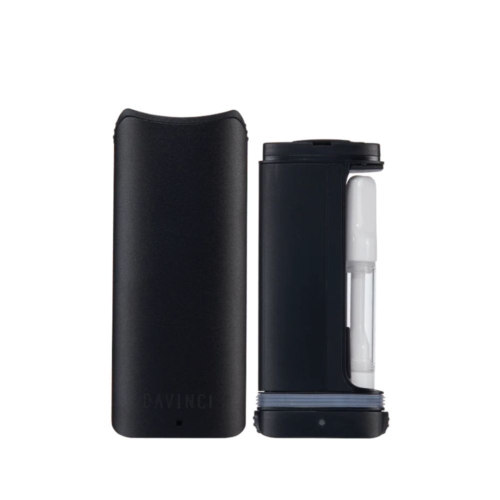
DaVinci Artiq — Best Premium Button Battery
The DaVinci Artiq is one of the best high-end 510 batteries you can get if you’re a serious cartridge user. It cools your vapor through a long internal air path, and the strong aluminum shell protects your cart from drops and dirt. Three heat levels give you solid voltage control, and the large 760mAh battery lasts a long time and charges fast with USB-C. It comes with two mouthpieces — including one that works with a bong — plus a range of useful extras.
Best for: Users who want smooth, cooled hits with premium build quality and long battery life.
Price range: $55–$75
Hamilton Shiv — Best All-Around Button Battery
The Hamilton Shiv is a compact, well-built button-activated 510 battery that delivers reliable performance at a fair price. It features variable voltage, preheat, and a sturdy construction that holds up to daily use. The Shiv hits the sweet spot between budget pens and premium devices — you get real features and solid build quality without overpaying.
Key specs: Variable voltage, button-activated with preheat, compact form factor, USB-C charging.
Best for: Everyday users who want a dependable button battery with all the essential features at a reasonable price.
Price range: ~$45
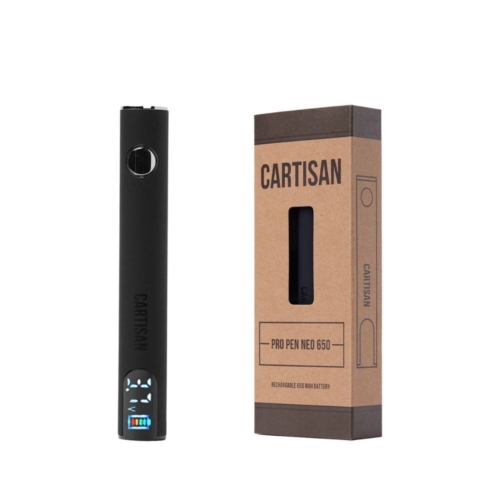
Cartisan Pro Pen — Best Button Pen-Style
The Cartisan Pro Pen brings a color digital screen to the classic pen-style form factor. It has five variable voltage settings, preheat, USB-C charging, and a 650mAh battery — all in a slim, pocketable design. The screen shows exact voltage and battery level, which is a nice upgrade over LED-only pens.
Key specs: 650mAh battery, 5 voltage settings, color digital screen, preheat, button-activated, USB-C.
Best for: Users who want pen-style portability with box-mod features.
These picks prioritize the clean simplicity of inhale-activated firing.
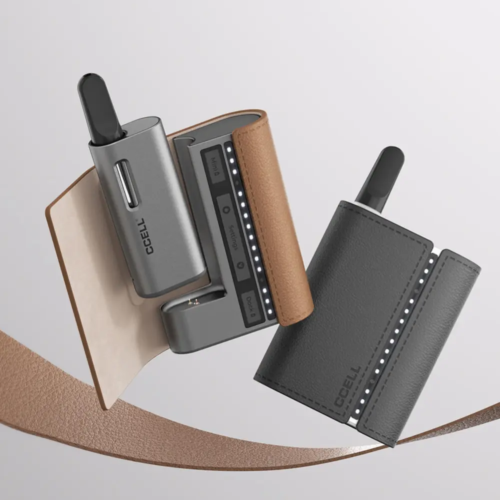
CCELL Fino — Best Premium Auto-Draw
The CCELL Fino is a beautifully designed auto-draw battery wrapped in a removable, magnetically attached leather case that resembles a compact wallet. It features eight voltage settings (2.2V–3.6V), a 10-second preheat mode, and a detachable mini battery that operates independently from the 1000mAh power dock. Draw-activated firing with a magnetic cartridge system makes it effortless to use.
Key specs: 190mAh mini battery + 1000mAh dock, 8 voltage settings, draw-activated, preheat, magnetic cart system, USB-C charging, leather exterior.
Best for: Style-conscious users who want premium auto-draw with extensive voltage control.
Price range: $45–$60
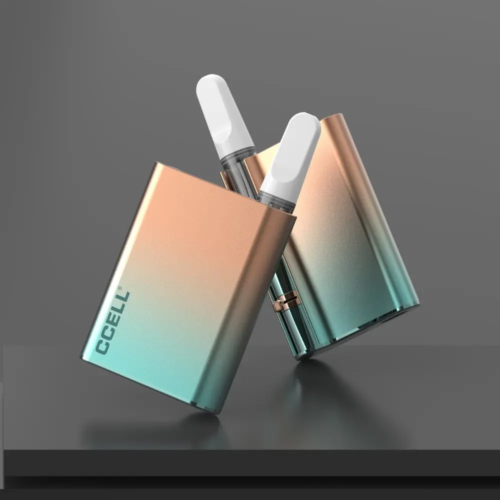
CCELL Palm Pro — Best Mid-Range Auto-Draw
The CCELL Palm Pro is a compact palm-style auto-draw battery from one of the most trusted names in the vape industry. CCELL is known for their ceramic coil technology and consistent quality. The Palm Pro offers a slim, ergonomic form factor with draw-activated firing that responds quickly and reliably. It’s a straightforward, no-fuss auto-draw battery that just works.
These batteries give you the flexibility of both activation methods in one device.
Cartisan EVO Pro — Best Overall Hybrid
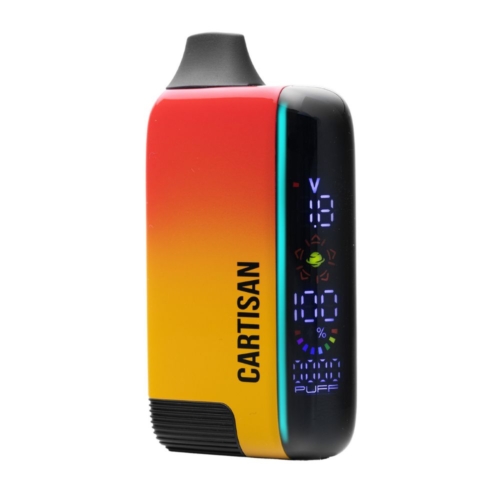
The Cartisan EVO is a discreet concealed battery with a massive 1000mAh capacity, variable voltage adjustable in precise 0.1V increments from 1.8V to 4.2V, and both button and auto-draw activation. It also includes a wax atomizer attachment for concentrate users. The EVO packs serious power and precision into a stealthy package.
Key specs: 1000mAh battery, voltage adjustable 1.8V–4.2V in 0.1V steps, button + auto-draw, concealed cart design, wax compatible, USB-C.
Best for: Power users who want maximum control and maximum battery life in a concealed form factor.
Price range: $35–$50
Randy’s Inspo XL — Best Value Hybrid
The Randy’s Inspo XL is disguised to look like a disposable vape (styled like an Elf Bar), concealing the cartridge within its body for excellent discretion. It has a 650mAh battery, three voltage settings, auto-draw activation with a button for preheat and voltage cycling, and an included wax attachment. Strong performance at a competitive price makes it a standout value pick.
Best for: Budget-conscious users who want hybrid activation and discretion without breaking the bank.
Price range: $25–$35
Yocan UNI 3.0 — Best Premium Hybrid
The Yocan UNI 3.0 continues the legacy of one of the most popular 510 batteries ever made. It features an HD animation screen, adjustable cartridge height and width for universal compatibility, variable voltage, preheat, and a solid 650mAh battery — all with both button and auto-draw activation. The UNI series set the standard for adjustable cart batteries, and the 3.0 refines everything with dual-mode firing.
Key specs: 650mAh battery, adjustable voltage (stepped), button + auto-draw, HD animation screen, adjustable cart slot for all sizes, preheat, USB-C charging.
Best for: Users who want the most versatile, feature-packed hybrid battery with universal cart compatibility.
Free shipping on orders $40+ · All batteries include USB-C charger
Frequently Asked Questions
Can I switch from auto-draw to button-activated on the same battery?
Only if you have a hybrid battery that supports both modes. A pure auto-draw battery can’t be converted to button-activated (and vice versa) because the hardware is different. If you want both options, buy a hybrid from the start.
Do auto-draw batteries work with all 510 cartridges?
Yes. The activation method is entirely on the battery side — it has nothing to do with the cartridge. Any standard 510-threaded cartridge works with any 510 auto-draw battery, button battery, or hybrid. The 510 threading standard ensures universal compatibility.
Are auto-draw batteries less powerful than button batteries?
Not inherently. Power output depends on the battery’s voltage, not the activation method. A 3.6V auto-draw battery delivers the same power to the coil as a 3.6V button battery. However, auto-draw batteries are more likely to be fixed at a single voltage, while button batteries usually offer adjustable voltage — giving you access to both lower and higher power levels.
Which type lasts longer?
Battery lifespan depends on mAh capacity, build quality, and how you use it — not the activation type. A 650mAh battery lasts the same whether it’s button or auto-draw. However, auto-draw batteries can lose charge faster if they experience frequent accidental activations. See our mAh size guide for detailed battery life comparisons.
Why does my auto-draw battery sometimes fire on its own?
This is usually caused by oil residue or condensation on the airflow sensor. Clean the mouthpiece area and the connection port. If the problem persists, the sensor may be defective. Ghost-firing is more common in budget auto-draw batteries — reputable brands use better-calibrated sensors.
Are button batteries harder to use?
Not really. The “learning curve” amounts to about 30 seconds: press and hold the button while you inhale. That’s it. The 5-click on/off and 3-click voltage cycle are also intuitive once you do them once. Most people who start with button batteries never think about it after the first session.
Can I use preheat on an auto-draw battery?
Only on hybrid models that include a button for preheat. Pure auto-draw batteries (with no button at all) can’t preheat because there’s no way to activate the battery without airflow. If you need preheat, look for a hybrid or a button-activated battery.
Is one type more durable than the other?
Button batteries have a physical mechanical component (the button) that can wear out over time, especially on cheaper models. Auto-draw batteries have an electronic sensor that doesn’t physically degrade the same way, but can malfunction if exposed to moisture or oil leaks. In practice, both types last about the same — what matters most is the overall build quality of the specific battery you buy. See our most durable cart batteries guide for the toughest options.
Which is better for beginners?
Auto-draw is easier for absolute beginners because it requires zero technique — just inhale. However, a button battery is only marginally more complex and gives you features you’ll appreciate as you gain experience. Our recommendation for new users who plan to vape regularly: get a hybrid so you can start with auto-draw and naturally graduate to using button features as you learn what you prefer.
Do dispensary carts work better with one type?
Dispensary carts (THC oil cartridges from licensed dispensaries) are standard 510-threaded and work equally well with both types. However, many dispensary carts use thicker oils (especially live resin), which benefit from the preheat feature found on button and hybrid batteries.
The Verdict: Which Should You Buy?
Here’s the honest answer: in 2026, get a hybrid battery unless you have a specific reason not to.
Hybrids give you auto-draw simplicity for everyday casual use and button features (preheat, voltage control, lock mode) when you need them. You don’t have to choose one activation style and live with its limitations. The price difference between a good hybrid and a good button-only or auto-draw-only battery is minimal — usually $5–$10.
That said, here are the exceptions:
Get a pure button battery if: You want the widest feature set possible, don’t care about auto-draw, and want a proven, traditional 510 battery experience. Pen-style button batteries are also the most affordable entry point ($10–$20).
Get a pure auto-draw battery if: Simplicity is your absolute top priority, you only use thin distillate carts, and you want zero learning curve. Some people just prefer the clean, buttonless experience.
Regardless of which type you choose, stick to reputable brands (Vessel, Yocan, CCELL, Cartisan, Randy’s, Ooze, PRTBL) and avoid the cheapest options. A $15–$40 battery from a known brand will outlast and outperform a $5 battery from a random seller every time.
Important: These products are for adults 21+ only. Follow all local and state laws regarding cannabis and vaping products. Use responsibly and store safely away from children and pets.
Written by Marc Pitts
Marc is the CEO of Discount Vape Pen and has spent over 11 years in the vape industry. He began his career owning and operating brick-and-mortar vape shops, giving him hands-on experience with both products and customer needs. A Kean University graduate from Westfield, NJ, Marc combines retail expertise with a deep understanding of the evolving vaping landscape.
Outside of work, Marc loves cooking Italian food, swimming, playing tennis, and attending Broadway shows — a true theater kid at heart. Meet all our Discount Vape Pen Authors here.