
510 Thread Explained: Why It’s the Universal Vape Standard (2026)
If you’ve ever bought a vape cartridge from one brand and screwed it onto a battery from a completely different brand — and it just worked — you’ve experienced the power of the 510 thread standard. It’s the reason the vaping industry functions as well as it does, and it’s something most users benefit from every day without ever thinking about it.
But what actually is 510 threading? Why did this specific design become the universal standard instead of the dozens of other connection types that existed? And does it matter to you as a consumer in 2026?
This guide answers all of those questions. We’ll cover the technical specifications behind the 510 thread, the history of how it took over the industry, why it beat out every competitor, what it means for your cartridge and battery compatibility, and where the standard is headed. Whether you call your device a cart battery or a 510 thread battery, understanding the threading that connects everything is foundational knowledge for any vape user.
Table of Contents
- What Is 510 Threading?
- What Does “510” Actually Mean?
- Technical Specifications
- The History of 510 Thread: How It Became Universal
- Why 510 Beat Every Other Threading Type
- What Happened to 601, 808, and eGo Threads?
- 510 Thread Compatibility: What Works With What
- What’s NOT 510 Thread (Pod Systems and Proprietary Connections)
- Anatomy of the 510 Connection
- Why the 510 Standard Matters to You
- Common Myths About 510 Threading
- The Future of 510 Thread
- How to Protect Your 510 Threading
- Shopping for 510 Products: What to Look For
- Frequently Asked Questions
🛒 Already Know What You Need?
Shop All 510 Thread Batteries →
Shop Empty 510 Cartridges →
Read Our Best 510 Batteries 2026 Guide →
What Is 510 Threading?
510 threading is the standardized screw connection used to attach vape cartridges to vape batteries. It’s a specific thread pattern — defined by its diameter and thread count — that allows components from different manufacturers to connect seamlessly. When your cartridge screws onto your battery, the 510 thread is the interface making that connection.
Think of 510 threading as the USB of the vaping world. Just like USB became the universal standard for connecting devices to computers (replacing dozens of proprietary connectors), 510 threading became the universal standard for connecting cartridges to batteries. It doesn’t matter who made your cartridge or who made your battery — if both use 510 threading, they’ll work together.
This standardization is what makes the entire cartridge-and-battery ecosystem possible. You can buy a THC cartridge from a dispensary in Colorado, a CBD cart from an online retailer in Oregon, and a battery from a completely different company — and they all connect and function because they all use the same 510 thread specification.
What Does “510” Actually Mean?
The name “510” comes directly from the physical measurements of the threading:
- 5 — The threading connector is approximately 5 millimeters in diameter
- 10 — There are 10 threads (screw rotations) on the connector
That’s it. The name is purely descriptive — it tells you the size and thread count of the connection. There’s no hidden meaning, no inventor’s initials, no model number. It’s 5mm wide with 10 threads.
More precisely, the threading uses an M7×0.5 metric specification (7mm outer thread diameter with 0.5mm pitch), but the “510” naming convention stuck because it was simpler and more memorable. The vaping industry adopted this shorthand early on, and it became the standard way to refer to this connection type.
Technical Specifications
For those who want the precise engineering details, here are the full technical specifications of the 510 thread standard:
| Specification | Detail |
|---|---|
| Thread type | M7×0.5 metric |
| Outer thread diameter | 7.0mm |
| Thread pitch | 0.5mm (distance between threads) |
| Thread count | 10 threads |
| Connector pin diameter | ~2.0mm (center contact pin) |
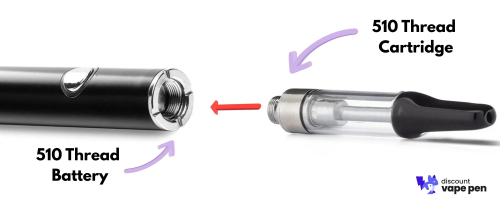
| Connection type | Male (cartridge) into Female (battery) |
| Electrical contacts | Center pin (positive) + outer threads (ground) |
| Tightening | Hand-tight only (no tools) |
What These Specs Mean in Practice
The M7×0.5 threading is fine enough to provide a secure connection without requiring excessive rotation to attach. You typically only need 2–3 full turns to screw a cartridge onto a battery securely. The fine pitch also means the connection is less likely to cross-thread (where the threads don’t align properly and the screw jams).
The center contact pin is the positive electrical terminal — this is where power flows from the battery to the cartridge’s heating coil. The outer threads serve as both the mechanical connection (holding the cart to the battery) and the electrical ground (completing the circuit). This dual-purpose design is elegant in its simplicity — no extra wires, pins, or connectors needed.
The “hand-tight only” specification is important. 510 connections are designed to be finger-tightened until snug. Using pliers or any tool to tighten will damage the threading and can push the center contact pin too far down, breaking the electrical connection. If you’re having connection problems, the fix is almost never “tighten harder” — it’s usually the opposite. We cover this in detail in our battery troubleshooting guide.
The History of 510 Thread: How It Became Universal
The 510 thread didn’t become the universal vaping standard by accident. It earned that position over nearly two decades through a combination of good design, early adoption, and market forces that gradually eliminated every competitor.
2007–2009: The Birth of 510
The 510 thread was introduced by Joyetech, a Chinese electronics manufacturer, around 2007 as part of their early e-cigarette designs. At this time, the vaping industry barely existed — it was a small community of early adopters using crude, cigarette-sized devices primarily for nicotine delivery.
Joyetech’s 510 design was one of many competing connection types. Other manufacturers were developing their own proprietary threading: 306, 401, 601, 808, and several others. There was no standard, and components from different brands rarely worked together.
2009–2012: The Standards War
During this period, the vaping industry grew rapidly and the lack of standardization became a real problem. Consumers were frustrated that buying a new tank or atomizer often meant buying a new battery too. Retailers struggled to stock compatible combinations. The industry needed a universal standard.
Several threading types competed for dominance, with 510, 601, and 808 being the most popular. The 510 thread gradually pulled ahead for several reasons we’ll detail in the next section. By around 2010–2012, most new devices were being designed with 510 compatibility, and the other standards began dying off.
2012–2016: 510 Wins the War
By 2012, 510 threading had reached critical mass. The majority of atomizers, tanks, and batteries used 510 connections. Third-party adapters existed to convert other thread types to 510, which further cemented its dominance — if you could adapt anything TO 510, why not just make it 510 from the start?
During this period, the vaping industry also shifted from nicotine-focused e-cigarettes to a broader market including cannabis oil cartridges, dry herb atomizers, and wax concentrates. All of these new product categories adopted 510 threading by default because it was already the established standard.
2016–2020: Oil Cartridges Cement 510 Permanently
The explosion of cannabis legalization across the United States created a massive new market for oil cartridges — and virtually every cartridge manufacturer chose 510 threading. This wasn’t even a decision that required debate. By 2016, 510 was so dominant that using anything else would have been commercial suicide.
The oil cartridge boom brought millions of new users into the 510 ecosystem. For many people, a 510 battery was their first vaping device. The standard went from “industry standard” to “the only standard most users have ever known.”
2020–2026: Universal and Unchallenged
Today, 510 threading is used by an estimated 95%+ of all cartridge-based vaping devices worldwide. The remaining 5% are proprietary pod systems (like PAX Era and Stiiizy) that intentionally chose to lock users into their ecosystem — a strategy that works for brand loyalty but limits consumer flexibility.
The 510 thread has proven remarkably durable as a standard. Despite nearly two decades of technological advancement in battery design, materials, and electronics, nobody has found a compelling reason to replace the basic threading connection. It works, it’s simple, and the entire supply chain is built around it.
Why 510 Beat Every Other Threading Type
The 510 thread’s victory over competing standards wasn’t random. Several specific advantages made it the natural winner:
1. Physical Size Was Ideal
The 510 connector hit a sweet spot in physical dimensions. It was small enough to keep devices compact (critical for portability), but large enough to provide a reliable mechanical connection and adequate electrical contact. Smaller threading types like the 306 were fragile and had weak connections. Larger types like the 601 made devices unnecessarily bulky.
2. The Thread Pitch Was Forgiving
The 0.5mm pitch (distance between threads) was fine enough to provide secure attachment but coarse enough to be easy to align by hand. This reduced cross-threading — a common problem with finer-pitched connections where the threads would jam if not perfectly aligned. The 510’s “forgiveness” made it more user-friendly than competitors.
3. First-Mover Advantage in Accessories
Joyetech and other early 510 adopters created a wide ecosystem of compatible accessories — tanks, drip tips, atomizers, and batteries. Because more accessories existed for 510 than any other standard, consumers gravitated toward 510 devices, which attracted more accessory manufacturers, which attracted more consumers. This virtuous cycle was difficult for competing standards to break.
4. The Connection Was Mechanically Sound
The male/female screw design with a spring-loaded center pin proved extremely reliable. The spring on the battery’s center contact accommodated slight variations in cartridge manufacturing without losing electrical connection. Other standards used rigid pin designs that were less tolerant of manufacturing inconsistencies.
5. Dual-Purpose Threading (Mechanical + Electrical)
Using the threads as both the physical connection and the electrical ground eliminated the need for additional connectors or wires. This simplified manufacturing, reduced cost, and minimized failure points. Competing designs that separated mechanical and electrical connections were more complex and more failure-prone.
6. Adapters Made Competing Standards Obsolete
Once 510-to-601, 510-to-808, and other adapters became widely available, consumers could convert their existing non-510 devices to work with 510 accessories. This removed the last reason to buy non-510 products — you could use the 510 ecosystem regardless of what battery you owned. Competing standards couldn’t offer this because nobody was making adapters in the other direction.
What Happened to 601, 808, and eGo Threads?
If you’ve been vaping for a while — or if you’ve stumbled across old forum posts and product listings — you may have seen references to other threading types. Here’s what happened to each of the 510’s main competitors:
601 Thread
The 601 thread was the most serious competitor to 510. It was slightly larger in diameter and used a different thread pitch. For a brief period in 2008–2011, 601 devices were popular, particularly in certain e-cigarette models.
601 lost to 510 primarily because it was physically larger without offering any meaningful benefit. The bigger connector made devices bulkier, and the threading was slightly more prone to cross-threading. As the 510 ecosystem grew, 601 manufacturers either switched to 510 or went out of business. By 2014, 601 was essentially extinct.
If you still have a 601 device: It’s obsolete technology. 601-to-510 adapters exist but add unnecessary bulk and can cause connection problems. Upgrading to a modern 510 battery is the better move.
808 Thread
The 808 thread was used primarily in early “KR808” cigarette-style e-cigarettes. It was even larger than the 601 and designed for a different form factor. The 808 never gained significant market share outside of a few specific brands and faded out by the early 2010s.
eGo Thread
The eGo thread is a special case. Rather than competing with 510, the eGo standard was designed to coexist with it. eGo batteries featured a larger outer threading (for eGo-specific tanks) while also including a 510 connector in the center. This meant eGo batteries could use both eGo tanks AND 510 cartridges.
This dual-compatibility design was clever but ultimately worked in 510’s favor. Because eGo batteries could accept 510 attachments, users who started with eGo devices naturally migrated into the 510 ecosystem. By the time eGo-specific tanks fell out of fashion, all those users already had 510-compatible setups.
Today, the eGo thread exists mainly as a historical curiosity. Some budget batteries still use eGo-style charging (the screw-on USB charger), but the actual eGo tank connection is effectively dead.
306, 401, and Other Obscure Standards
Several other threading types existed briefly in the 2007–2010 era, including 306, 401, and various proprietary connections. None achieved significant market share, and all were extinct by 2012. Most users in 2026 have never encountered these standards.
510 Thread Compatibility: What Works With What
One of the greatest benefits of the 510 standard is universal cross-brand compatibility. Here’s what that means in practice:
Any 510 Cartridge + Any 510 Battery = Compatible
This is the core promise of the 510 standard. A THC distillate cartridge from a California dispensary will screw onto a Yocan battery bought online. A CBD cartridge from a hemp retailer will work with a CCELL battery from a smoke shop. A Delta-8 cart will work with any 510 battery you already own.
Brand doesn’t matter. Where you bought it doesn’t matter. What oil is inside doesn’t matter. If the cartridge and battery both have 510 threading, they connect and function.
What IS Compatible (510 Thread)
- All standard oil cartridges — THC, CBD, Delta-8, Delta-9, Delta-10, CBG, CBN, nicotine oil, and other concentrates in 510-threaded carts
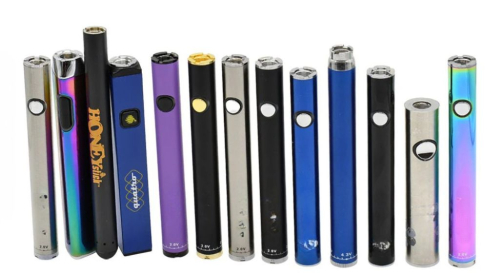
- All 510 batteries — pen-style, box-style, concealed, auto-draw, button-activated, and hybrid models
- 510 wax atomizers — concentrate atomizers that screw onto 510 batteries for dabbing
- 510 dry herb atomizers — dry herb chambers that connect via 510 threading
- Magnetic adapters — 510 magnetic adapters that replace threading with a magnetic snap connection for convenience
The One Compatibility Caveat: Physical Size
While the threading itself is universal, physical size can be a limiting factor. Not every 510 battery can physically accommodate every 510 cartridge:
Standard cartridges (0.5mL and 1mL) are typically 10–11mm in diameter and work with every 510 battery on the market. No compatibility issues.
Large cartridges (2g and above) have wider bodies (up to 14mm diameter) and taller profiles. Some batteries — especially slim pen-style models and concealed batteries with narrow openings — can’t physically fit these larger carts even though the threading connects fine. If you use 2g carts, look for batteries specifically marked as 2g compatible.
This isn’t a threading compatibility issue — the 510 connection works regardless. It’s a form-factor issue, like trying to fit a large phone into a small case. The phone and case are “compatible” in theory, but the physical dimensions don’t match.
What’s NOT 510 Thread
While 510 dominates the cartridge battery market, a few product categories use different connection types. It’s important to know these so you don’t accidentally buy incompatible products:
Proprietary Pod Systems
Some brands use proprietary magnetic or snap-in connections instead of 510 threading. The most notable examples include:
- PAX Era — Uses a proprietary magnetic pod connection. PAX Era pods only work with PAX Era batteries.
- Stiiizy — Uses a proprietary magnetic pod. Stiiizy pods only work with Stiiizy batteries.
- JUUL — Uses a proprietary magnetic pod. JUUL pods only work with JUUL devices (though JUUL-compatible pods exist from third parties).
These brands intentionally chose proprietary connections to lock users into their ecosystem. If you buy a PAX Era battery, you can only use PAX Era pods — you can’t use the thousands of 510-threaded cartridges available from other brands. This is the opposite of the 510 philosophy.
How to tell the difference: If a product says “pod” instead of “cartridge,” it’s probably a proprietary system. If it says “cartridge” or “cart,” it’s almost certainly 510. When in doubt, check the product description for “510 thread” or “510 compatible.”
Disposable Vapes
Disposable vapes are all-in-one devices with the battery and cartridge permanently combined. There’s no threading at all because you never need to attach or detach anything. When the oil runs out (or the battery dies), you dispose of the entire unit.
Disposables are convenient but more expensive per session than using a rechargeable 510 battery with replaceable cartridges. Many users start with disposables and then transition to the 510 system for cost savings and better control over their experience.
Anatomy of the 510 Connection
Understanding the physical parts of a 510 connection helps with troubleshooting and maintenance. Here’s what’s happening at the point where your cartridge meets your battery:
On the Battery (Female Side)
510 threading (internal): The recessed, threaded opening where the cartridge screws in. These threads are cut into the inside wall of the connector.
Center contact pin (spring-loaded): A small metal pin in the center of the connector, usually gold or silver colored. This is the positive (+) electrical terminal. It’s spring-loaded to maintain contact with the cartridge’s bottom pin, accommodating slight variations in cartridge depth. This spring is what allows different brands’ carts to all make good electrical contact.
Airflow channel: On auto-draw batteries, there’s an airflow path around or through the connector that leads to the airflow sensor. This channel needs to stay clear for the sensor to function.
On the Cartridge (Male Side)
510 threading (external): The raised threads on the outside of the cartridge’s base connector. These screw into the battery’s internal threads.
Center contact pin (fixed): A small metal pin on the very bottom of the cartridge, slightly recessed from the threading. This is the cartridge’s positive terminal and must make contact with the battery’s spring-loaded pin to complete the circuit.
Insulating ring: A thin insulating ring (usually rubber or ceramic) separates the center pin from the outer threads. This prevents a short circuit between the positive pin and the grounded threads.
How the Connection Completes the Circuit
When you screw a cartridge onto a battery:
- The outer threads mechanically lock together, holding the cart firmly in place
- The battery’s spring-loaded center pin pushes up against the cartridge’s fixed center pin
- This completes the electrical circuit: power flows from battery → center pin → cartridge coil → outer threads → back to battery
- When the battery is activated (button press or auto-draw), current flows through this circuit, heating the coil and vaporizing oil
This is why connection problems are the most common cause of a cart battery “not working.” If either center pin isn’t making proper contact — because of overtightening, oil residue, or a depressed pin — no power reaches the coil and you get no vapor.
Why the 510 Standard Matters to You
Understanding 510 threading isn’t just trivia — it has real, practical benefits for your wallet and your experience:
Freedom to Choose
Because 510 is universal, you’re never locked into one brand. You can buy the best battery from one company and the best cartridge from another. You can try cartridges from different dispensaries, different oil types, and different brands without worrying about compatibility. This freedom to mix and match is something proprietary pod system users don’t have.
Cost Savings
The 510 standard creates competition among manufacturers, which drives prices down. You can find quality 510 batteries starting around $15 and cartridges at every price point. Proprietary systems like PAX Era charge premium prices because they know their users can’t switch to a cheaper alternative without replacing the battery too.
Longevity
A good 510 battery will work with cartridges for years to come because the standard isn’t changing. The battery you buy today will be compatible with cartridges released in 2027, 2028, and beyond. This isn’t guaranteed with proprietary systems, which can be discontinued at any time (leaving you with an incompatible battery and no way to use it).
Variety
The 510 ecosystem offers vastly more product variety than any proprietary system. Want a concealed battery? A battery with a built-in bubbler? A novelty battery shaped like something fun? A luxury battery with premium materials? All of these exist in the 510 ecosystem. Proprietary systems offer one or two battery options — period.
Common Myths About 510 Threading
Myth: “510 thread is outdated technology”
False. The threading connection is simple by design, but the batteries and cartridges that use 510 threading are constantly evolving. Modern 510 batteries feature OLED screens, precise voltage control in 0.1V increments, 1000mAh+ batteries, haptic feedback, and USB-C fast charging. The threading is just the connector — it doesn’t limit the technology built around it, just like the headphone jack didn’t limit the quality of the headphones plugged into it.
Myth: “Some 510 batteries work better with certain brands of carts”
Mostly false. The electrical connection is the same regardless of brand combinations. What CAN affect performance is whether the battery’s voltage setting is appropriate for the cartridge’s oil type. But that’s a voltage issue, not a threading compatibility issue. Any 510 battery at the right voltage will perform well with any 510 cart.
Myth: “You need to ‘match’ your battery brand to your cart brand”
False. This is one of the most persistent misconceptions. You absolutely do not need a CCELL battery for CCELL carts, or a Yocan battery for Yocan atomizers. The entire point of the 510 standard is cross-brand compatibility. Mix and match freely.
Myth: “Magnetic connections are replacing 510 threads”
Partially true, but misleading. Some modern batteries use magnetic adapters that snap onto your cartridge’s 510 threading instead of screwing directly. But the cartridge itself still has 510 threads — the magnet adapter simply converts the screw connection to a magnetic one for convenience. The 510 standard is still the foundation; magnets are just an accessory layer on top of it.
Myth: “510 threading wears out quickly”
False with proper use. 510 threading is metal machined into the connectors. With normal hand-tightening and occasional cleaning, the threads will outlast the battery’s electrical components by years. Threading damage almost always comes from overtightening, cross-threading (forcing a misaligned connection), or dropping the device on the connector.
The Future of 510 Thread
Will 510 threading eventually be replaced? Almost certainly not in the near future, and possibly not ever. Here’s why:
Network effects are powerful. The entire global supply chain — cartridge manufacturers, battery manufacturers, dispensaries, retailers, and hundreds of millions of consumers — is built around 510. Switching to a new standard would require everyone to change simultaneously, which is practically impossible without a compelling reason.
The connection isn’t the bottleneck. Every meaningful advancement in vaping technology (better batteries, smarter electronics, improved coil design) happens in the components connected BY the 510 thread, not in the thread itself. The threading is just a simple mechanical and electrical interface — it doesn’t limit innovation.
No superior alternative exists. Magnetic connections are convenient but sacrifice the secure mechanical lock that screwing provides. Proprietary systems restrict consumer choice. Bayonet-style connections (twist-lock) haven’t proven more reliable. Nobody has designed a connection type that’s clearly better enough to justify abandoning the installed base of billions of 510 devices.
The most likely future is that 510 threading remains the standard for traditional cartridge-and-battery setups, while proprietary pod systems continue to exist as a separate market segment for users who prefer brand-specific ecosystems. The two will coexist, with 510 maintaining its dominant market share.
How to Protect Your 510 Threading
Your 510 threads are durable, but they’re not indestructible. Here’s how to keep them in top condition:
Do:
- Hand-tighten only — Finger-tight is all you need. The connection should feel snug, not forced.
- Align before screwing — Place the cartridge straight on the battery and turn gently. If you feel resistance before it’s seated, back off and realign.
- Clean regularly — Use a cotton swab with rubbing alcohol (70% isopropyl or higher) to clean the threads and center pin. Oil residue builds up over time and causes connection problems. Weekly cleaning for daily users, monthly for occasional users.
- Store upright — When not in use, store your battery standing up with the 510 connector facing up. This prevents oil from seeping down into the threading.
- Remove carts for long-term storage — If you’re not going to use your battery for a week or more, unscrew the cartridge. Leaving a cart attached for extended periods increases the chance of oil leaking into the threading.
Don’t:
- Never overtighten — This is the number one cause of 510 connection problems. Overtightening pushes down the spring-loaded center pin, breaking the electrical contact.
- Never cross-thread — If the cartridge doesn’t screw on smoothly, stop. Back it out and try again. Forcing a misaligned connection strips the threads permanently.
- Never use tools — Pliers, wrenches, or any tool will damage the threading and void your warranty.
- Never submerge in water — While you should clean the threading, don’t soak it. Moisture in the connector can cause short circuits.
- Never blow into the connector — If oil gets in the threads, clean it with a swab. Blowing into it can push debris deeper into the connection.
For a comprehensive maintenance routine, see our 510 battery care and charging guide.
Shopping for 510 Products: What to Look For
Now that you understand the 510 standard inside and out, here’s how to use that knowledge when shopping:
Buying a 510 Battery
The threading itself is standard, so your decision comes down to the features built around it. Focus on:
- Battery capacity (mAh) — How long it lasts between charges. 500–650mAh is the sweet spot for most users. See our mAh size guide for detailed recommendations.
- Voltage control — Variable voltage lets you optimize for different oil types. Our voltage settings guide explains what settings work best.
- Activation type — Button, auto-draw, or hybrid. Each has trade-offs. See our button vs auto-draw comparison for a full breakdown.
- Form factor — Pen-style for portability, box-style for features and battery life, concealed for discretion.
- Cart size compatibility — If you use 2g or larger carts, make sure the battery accommodates them.
- Preheat function — Essential for thick oils. Check our preheat battery collection.
- Brand reputation — Stick to known brands: Yocan, CCELL, Cartisan, Randy’s, Ooze, Hamilton Devices, DaVinci. Quality of threading machining varies significantly between reputable brands and cheap knockoffs.
Buying 510 Cartridges
For cartridges, the 510 threading is a given — focus instead on:
- Oil type and quality — Distillate, live resin, live rosin, full spectrum, etc.
- Coil material — Ceramic coils generally provide cleaner flavor than metal coils.
- Cart size — 0.5mL, 1mL, or 2g. Match to your battery’s physical capacity.
- If buying empty carts for filling — Check out our guide to the best empty 510 cartridges and our how to fill a vape cartridge tutorial.
🎯 Ready to Shop?
Browse All 510 Thread Batteries →
Browse Empty 510 Cartridges →
Browse 510 Adapters & Accessories →
Free shipping on orders $40+
Frequently Asked Questions
Is 510 thread the same as a cart battery?
Yes. “510 thread battery” is the technical name describing the connection type. “Cart battery” is the everyday colloquial term. They refer to the exact same device. We cover this in detail in our cart battery vs 510 battery comparison.
Will any 510 cartridge work with any 510 battery?
Yes, with one caveat: the cartridge needs to physically fit. Standard 0.5mL and 1mL carts work with every 510 battery. Large 2g+ carts may not fit in batteries with narrow openings or short connector wells. The threading always connects — it’s only the physical body dimensions that can be an issue.
How can I tell if my cartridge is 510 threaded?
Look at the bottom of the cartridge. If it has a small screw connector with external threads (raised metal spirals), it’s almost certainly 510. If it has a flat magnetic bottom, a snap-in connector, or no visible threading, it’s a proprietary pod system. In 2026, roughly 95% of cartridges on the market are 510 threaded.
Can I convert a non-510 device to 510?
For older threading types (601, 808, eGo), adapters do exist but are increasingly hard to find and add unnecessary complexity. For proprietary pod systems (PAX Era, Stiiizy), no adapter exists — these are intentionally incompatible with 510. The most practical solution is to purchase a 510 battery.
Does the quality of 510 threading vary between brands?
Yes, significantly. Reputable brands use precision-machined threading with tight tolerances, smooth engagement, and durable metal. Cheap knockoff batteries often have poorly machined threads that cross-thread easily, don’t seat cartridges properly, or wear out quickly. This is one of many reasons to buy from established brands.
Why do some batteries use magnetic adapters instead of direct threading?
Magnetic 510 adapters screw onto your cartridge’s 510 threads and then snap into the battery magnetically. This makes attaching and removing carts faster and more convenient — especially on concealed batteries where screwing can be awkward. The adapter still uses 510 threading on the cartridge side; it just converts the battery side to a magnetic connection. It’s an accessory, not a replacement for the standard.
Is 510 threading going to be replaced?
Not in any foreseeable timeframe. The entire industry — from cartridge manufacturers to battery makers to dispensaries — is built around 510 threading. There’s no technical pressure to change (the connection works fine) and no practical way to coordinate a universal switch to a new standard. Expect 510 to remain dominant for many years to come.
What’s the difference between 510 threading and eGo threading?
The 510 thread is a smaller, inner connection. The eGo thread is a larger, outer connection that was common on older vape devices. Many eGo batteries included BOTH threading types — an inner 510 connector plus an outer eGo connector. The eGo standard is essentially extinct in 2026; 510 is the only threading that matters for cartridge users.
Can 510 threading wear out?
With proper use (hand-tightening only, no cross-threading), 510 threads will outlast the battery’s electrical components. The threads are precision-machined metal and can withstand thousands of connections. Damage comes from misuse: overtightening, cross-threading, using tools, or dropping the device on the connector.
Do I need to lubricate 510 threads?
No. Never apply any lubricant to 510 threading. The threads need to make clean metal-to-metal contact for the electrical ground connection. Lubricant would insulate the threads and potentially cause connection problems. Just keep them clean with rubbing alcohol.
📚 Continue Learning
Complete Guide to Cart Batteries for Beginners →
510 Thread Battery: Complete Beginner’s Guide →
Cart Battery vs 510 Battery: What’s the Difference? →
Best Voltage Settings for Vape Cartridges →
Cart Battery mAh Size Guide →
Cart Battery Features Guide →
Button vs Auto-Draw Batteries →
Best Cart Batteries 2026: Complete Buyer’s Guide →
Last Updated: February 2026
Important: These products are for adults 21+ only. Follow all local and state laws regarding cannabis and vaping products. Use responsibly and store safely away from children and pets.

Written by Marc Pitts
Marc is the CEO of Discount Vape Pen and has spent over 11 years in the vape industry. He began his career owning and operating brick-and-mortar vape shops, giving him hands-on experience with both products and customer needs. A Kean University graduate from Westfield, NJ, Marc combines retail expertise with a deep understanding of the evolving vaping landscape.
Outside of work, Marc loves cooking Italian food, swimming, playing tennis, and attending Broadway shows — a true theater kid at heart. Meet all our Discount Vape Pen Authors here.